Website Design
This project is not purely about user experience. It is the capstone project for my master degree at Carnegie Mellon University. The project is divided into three parts: building cases analysis, guideline development, implement illustration.
I am glad you open this page. From here, I will start to tell you something that might help you improve your living quality.
01. Why this project?
The current building energy efficiency standards in the U.S. and other countries are significantly improved compared to several decades before, which is a good thing that the building energy efficiency would be mandatorily improved.
Meanwhile, the actual building energy efficiency improvement is not as we expected. There are several reasons for this phenomenon:
- The people’s awareness of the benefits of energy efficient buildings hasn’t kept up with the pace of standards’ improving speed;
- The technology is still not accessible in some country;
- The quantifiable benefits haven’t be summarized;
To solve this problem, I analyzed case studied to summarize natural conditioning benefits and classify the useful technologies in a website to make it reachable for people all over the world.
02. What is natural conditioning strategy
After getting a sense of the background, you might ask: so what is natural conditioning? Before answer this question, I should clarify that the definition is only intended to be valid for this project.
In my project, the term “natural conditioning” is used to describe the integrated building design strategy which would maximize the building resistance and adaptability to climate change. It is divided into four steps: energy conservation, passive strategies, active strategies, and renewable energy strategies.
- Energy Conservation: Use building design strategies to minimize the building energy needs.
- Passive Strategies: use ambient energy sources instead of purchased energy like electricity or natural gas.
- Active Strategies: use purchased energy to keep the building comfortable.
- Renewable Energy Strategies: use clean energy to support the building energy needs.
03. How I organized the content?
To give people who are not familiar with the professional knowledge and terms an easier way to learn natural conditioning strategies, I started the website from a general introduction to detailed graph driven case studies. I also use a specific city to illustrate the benefits of natural conditioning strategies and how to adopt them.
Case study sorting
As I said before, this project is not purely a website design project. To educate people, I had found in total more than 40 building cases in three building categories that used the natural conditioning strategies and selected 24 the most featured to my database.
The I building a unified form for these case studies and generate an electronic copy for printing.


The form for case studies;
The case studies gave me a way to show people the cost and benefit for each natural conditioning strategy. To avoid too much paper printing work and keep the knowledge “sustainable” I created a section on the website for case studies.
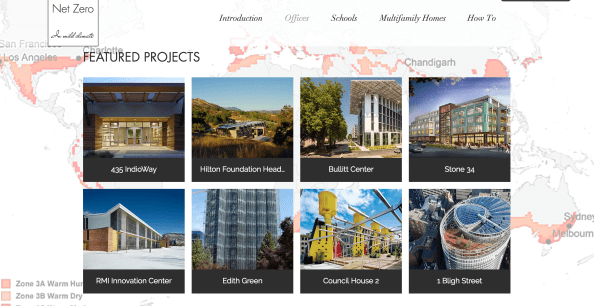
The website section for case studies;
Guideline developing
The second step I took was generating a useful guideline for people who wanted to adopt natural conditioning strategies.
Considering the primary audiences of this project were people who were interested in improving their living condition and might not know a lot of professional terms, I decided to create a step by step guide for people who really wanted to improve their house but didn’t know how.
So the main structure of my guideline was divided into three parts: technology introduction, benefit calculation, and implement guide.
Example choosing
The last step was illustrating the effectiveness of natural conditioning strategy. To better achieve it, I selected a city to visualize it. The city name’s Kunming, located in the southwest China. The reason I choose this city is that it has the mildest climate in China, but the buildings there are currently following the building energy efficiency code for most of the coastal cities in China. This situation makes Kunming the perfect example source for my project.
Using the weather data file and other relevant data (geological data, demographical data, etc.) in Kunming, I created the heat map to show the benefit of natural conditioning strategies and generated a matrix based on the advantages. This matrix included four categories: energy benefit, air quality benefit, acoustic quality benefit, and carbon footprint benefit.
04. Icon Design
A set of icons was designed for the relevant categories in the project. The icons were not only used in the final report but also utilized for the website layout.


05. Final deliverables
The website is the main deliverable for this project. The booklets and the matrix were included in my final report.
To view the website, click here.
 Yunlu Shi